Jazirah
An Alternate Arabian Peninsula
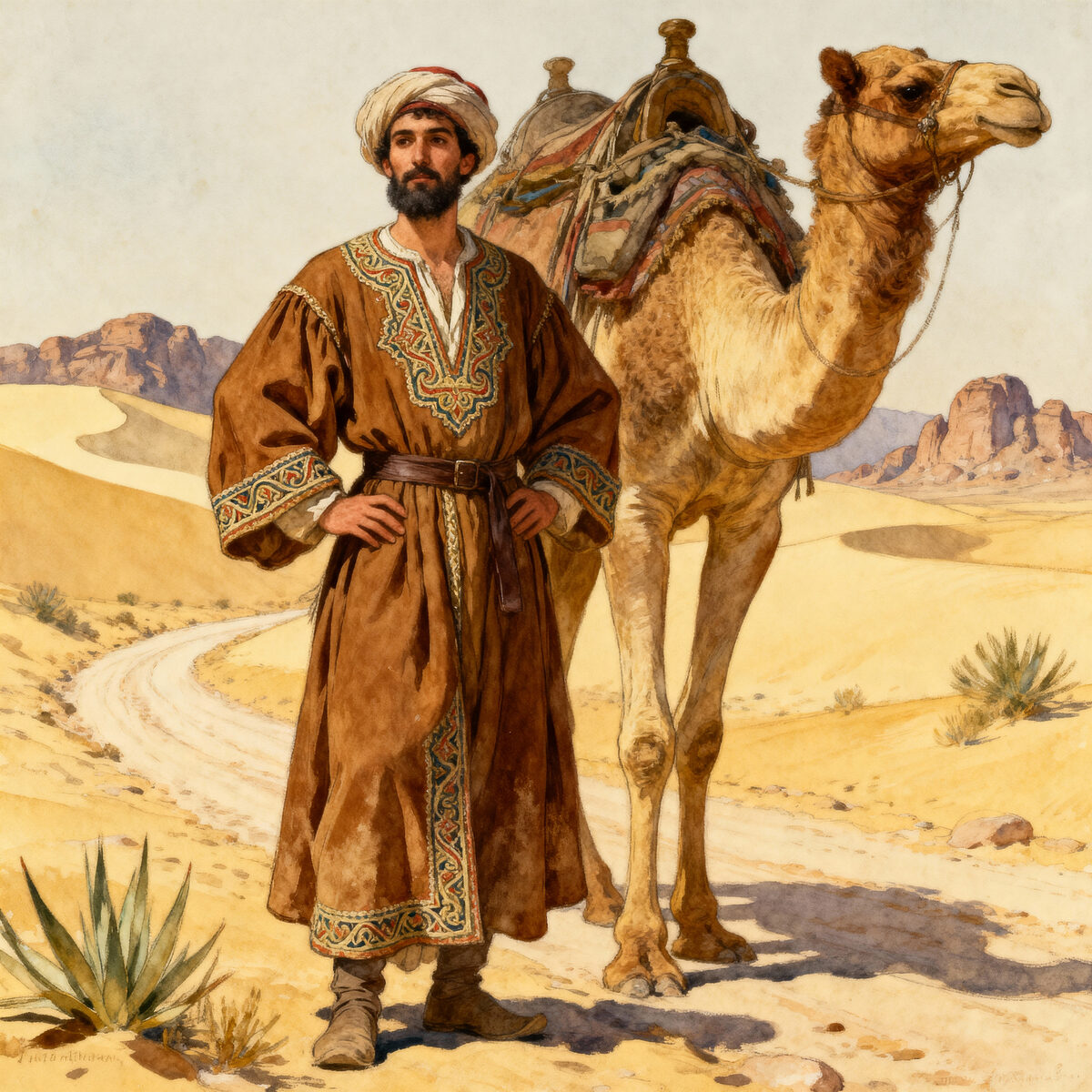
Desert that goes on until it decides to stop, and oases where the date palms provide the only shade for a day’s ride in any direction. Lean and sun-hardened, heads wrapped in keffiyeh held with the black agal, dressed in flowing white and earth-brown robes, the women wearing silver jewelry so knotted it takes a full apprenticeship to learn a single knot pattern. The horses are bred for endurance and heat and move like water over sand. The relationship between a rider and his mare is not discussed with strangers. The food is dates and flatbread and roasted lamb seasoned with cardamom, shared under goat-hair tents where the hospitality is not optional — you feed the stranger before you ask his name, and refusing to pour the coffee is an insult that has consequences. The curved jambiya at the hip is not decorative. The hilt is wrapped in silver wire worked into the silsila of the family’s lineage, and the master silversmiths who forge them are producing fewer each year, because factory work in Tsarigrad offers steady wages and the apprenticeship takes a decade.
The scent of frankincense still clings to the walls of the caravanserai, but the courtyard is empty. A hundred miles away, the smoke from a Valdaran steamship smudges the horizon of the Mesogeios, carrying the spice and the silk at a speed a camel cannot match. The Valdarans believe they have solved the problem of distance and call it progress. The Jaziri watch the smoke and know that the steamship is faster but also blinder, moving over the water without touching it, while the caravan moves through the land by becoming part of it.
Three thousand years of luxury trade, and you are watching it route around you. The Bedouin clans who knew every well-head and every star-path, the poets whose competitions could make or end a reputation, the pearl divers who descended on a weighted rope with a bone nose-clip, holding their breath past the point where the light changes and the water belongs to something else — the Valdaran administrator sees a wasteland to be bypassed, but the Jaziri sees a network of obligations, lineages, and arrangements with the land that the steamship will never encounter because it never slows down enough to be asked.
The gahwa ritual is the social binding that Valdara's industrial schedules cannot process. The coffee is roasted and pounded and poured in a set order: al-dhaif, the cup of the guest, which cannot be refused without insult; al-kaif, the cup of pleasure; and al-saif, the cup of the sword, which seals the mutual promise of defense. The time it takes to drink is the time required to establish who you are and whether your word has weight. The majlis is where the poetry of the Mu’allaqat carries the history of the clans, where the old names of the desert remain in active use, where the third cup is where the actual terms of anything are established. To rush the pouring is to announce that you are not strong enough to hold the peace.
The djinn of Jazirah are tribal and organized, bound by properly invoked names and ritual knowledge that the Bedouin poets preserved in verse, because verse survives where documents do not. The Marid of the deep water. The Ifrit of fire and old grievances. The Qareen who attaches to a person at birth and stays until death. A population of a world that exists alongside the visible one, operating by the same rules of hospitality and obligation that govern everything else in Jazirah. You either treat them correctly or you do not, and the consequences of both are well documented.
The falaj irrigation systems that the ancestors maintained for centuries crumble while the young dream of northern cities. The poetry competitions that once sparked tribal feuds still echo in the market squares. The date palms still provide sweetness and shade. But the conversations in the majlis increasingly turn to who has left and who is leaving next.
The Asāsīyyūn already speak a familiar language — desert ascetics who seek truth through direct encounter and who understand that the djinn and the divine operate by rules that bypass Valdaran categories entirely. The Aelfyn Sith’s Wilderkin understand that emptiness is a full place, and that the most important claims are the ones that look like nothing at all.
Reference Images
These images represent the visual direction for this region and were generated with OpenArt.
Grimmloch is an alternate reality — not a retelling of history. I have spent decades studying the stories of our own world so that each region feels grounded in something real, even when the fiction diverges. The map is not the territory. If I have, at any point, failed to honor the spirit of these cultures, please email me directly. I welcome the opportunity to address it.